farm jigsaw puzzle
Small Things Like TheseThe farm jigsaw puzzle is a modest object with an unusually long emotional life in Bill Furlong’s story: first an unanswered Christmas wish, then a softened account told to his daughters, and finally a real object he goes looking for as an adult. Its five hundred pieces give shape to what was missing, while its return exposes the distance between the childhood he remembers and the childhood he presents to his family.
The Christmas Wish
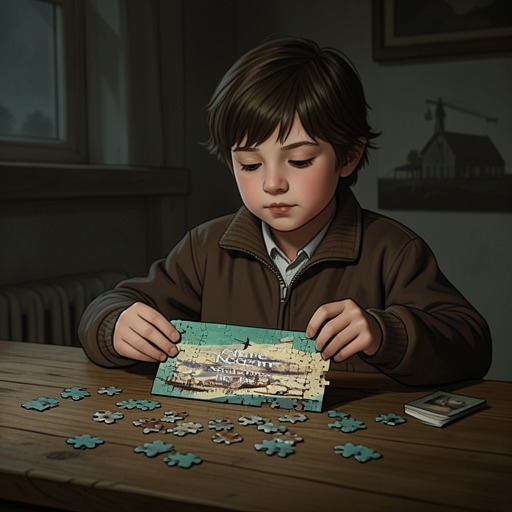
As a boy, Bill Furlong wrote to Santa asking for his father or, alternatively, a farm jigsaw puzzle in five hundred pieces. The wish joined two absences: the father he did not have and the ordinary present he hoped might at least make Christmas feel like a child’s Christmas.
On Christmas morning, in the drawing room Mrs Wilson sometimes let the children share, he found three parcels beneath the tree, all wrapped in the same green paper. One held a nailbrush and bar of soap; another, a hot-water bottle from Ned; the third, A Christmas Carol from Mrs Wilson, an old red-covered book with no pictures. There was no farm jigsaw puzzle. The difference between what he had asked for and what was waiting under the tree made the gifts painful rather than consoling.
He went out to the cow-house to hide his disappointment and cry. Remembering the name children at school called him, he took their treatment as the reason neither Santa nor his father had come and the puzzle had not arrived. Before returning indoors, he washed his face at the horse-trough, broke the ice, and held his hands in the cold water until he could no longer feel them, using physical cold to divert his hurt.
The Story Told to His Daughters
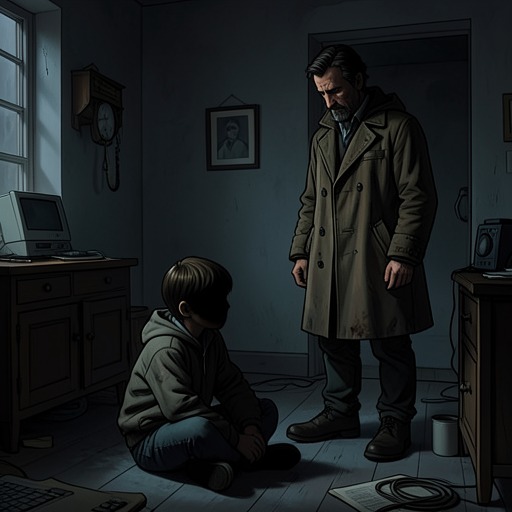
Years later, while his daughters wrote their Christmas letters at the table and Eileen unwound the iron’s cord, Furlong was pulled back into the memory. His mind was already occupied with work and the next day’s obligations, but the children’s preparations brought the old request into the present.
When a daughter questioned whether Santa had come to him, Furlong said that Santa had brought him a farm jigsaw puzzle one year. The claim directly reverses the memory the narrative has just supplied: he had asked for the puzzle and had not received it. His brief reassurance gives his daughters a more comforting version of his childhood, but his swallowed response and immediate direction to finish the letter leave the discrepancy visible. The object becomes not only a remembered deprivation but also something he cannot—or does not—tell his children plainly.
The Adult Search
After another year’s work was done, Furlong walked through the snow and looked into the town’s shop windows. At Stafford’s old shop, among familiar toys and games, he asked whether a farm jigsaw puzzle in five hundred pieces was available. The shopkeeper said that the puzzles kept there now were for children and that there was little demand for the more difficult ones; she offered to help him find something else.
Furlong shook his head. He did not buy a substitute puzzle, but he did buy a bag of Lemon’s jellies from a hook behind the shopkeeper, unwilling to leave with one arm apparently emptier than the other. The exchange leaves the specific wish unmet again: the shop has children’s puzzles, but not the difficult one he has named. The adult search therefore repeats the childhood absence without simply reproducing it; this time Furlong can ask directly, and can choose not to replace the object with something else.
Recurrence and Meaning
The farm jigsaw puzzle links three distinct moments: the boy’s written request, the father’s account to his daughters, and the man’s question in the old shop. In the first, it stands beside the wish for a father; in the second, its absence is covered by an invented success; in the third, the wish is spoken aloud but remains unfulfilled. The five hundred pieces persist as a precise measure of what he wanted, not a generic longing for a present.
Its importance lies in the contrast between a small, ordinary toy and the weight of the memories attached to it. The story does not show Furlong obtaining the puzzle. Instead, it lets the request recur across time, revealing how childhood shame can survive within adult family life and how a remembered lack may be easier to revisit through a shop counter than to explain at the Christmas table.